Showing posts with label social sciences. Show all posts

21 Feb 2012

Plagiarism versus the new online reality


Memiwanzi recently touches on the origin of the word plagiarism but in this one case, the meaning is far more interesting than the etymology to me.

Ah plagiarism and its related demon, intellectual property rights. With the digital age, "plagiarism" becomes terribly confusing morally and intellectually, if not effectively meaningless. Some intellectual issues follow:

1. Define "copy". Copying can be whole or in part, so at what point can the act of copying be sensibly called "plagiarism"? How can such a fuzzy delineation be made methodical and fair?

2. Define "author". On the net, what does "author" really mean if, say, someone remixes a preexisting song? What if the derivative work of another gains more social value than the original work of an original author? And then should one be paid for derivative works too? How derivative is "too derivative" though?

3. Define the basic moral issue with "plagiarism". Is plagiarism an issue about recognition of authorship, financial compensation, social appreciation, a combination of the above, or something else? Or is this more broadly about the fair compensation of any contributor (anonymous or otherwise, online or off) by means of any "currency" (based on financial value or some other value) according to the overall "value" of the contribution (evaluated by any kind of value or group of values)?

4. A new participatory economy? How might the pre-digital-age free-market model adapt to the new reality of open information exchange where "copying" is a gradient concept, "value" includes non-financial metrics, and where collective contribution and exchange blur the lines of an agent with her environment?

To resolve this pesky issue of plagiarism, we need a new digital economy that:
A) upholds the netizen's inherent right to copy and paste information.
B) recognizes doubly that mere copying adds no participatory value to the system.
C) sufficiently rewards contribution according to its measure of originality and overall social worth.
D) destroys any meaningful gain (in time and money) from stealing another person's work.

Cage Innoye has many interesting insights on just such an economy at his blog Diverse Philosophy. Whatever their exact details may be, competent solutions demand less laws and a more developed value theory.

1 Oct 2011

What if the problem is traditional academia?


Memiyawanzi raises an issue in Imposter syndrome about perfectionism run amok among linguistics students (and students by and large). I noticed that the focus is on the individual's internal psychology but I have an even broader perspective on this.


Individual quirks and psychoses

My life experience has led me to believe that many students who seem to naturally gravitate to scholarly pursuits have a common personality type. They tend to be detail-oriented for one and this can lead to this beautiful skill being turned inward on themselves for less constructive purposes (ie. perfectionism, self-doubt, anxiety, depression, etc.). Detail-oriented people, I believe, are precisely the kinds of people that will direct their psychic energy inward rather than outward, unlike the stereotypical jock who will instead gravitate towards physical pursuits to work off those same internal energies. If this inward reflection is used in a healthy way, one can properly evaluate one's weaknesses and adapt. If not, a student can be swamped by her own thought processes. All introspective, detail-oriented people need to learn to manage this hidden battle within themselves to stay on top.

However, we should also consider how environment must also play a part in a student's mental health. If an environment is unreasonable, we all know that it can contribute to an unhealthy mental state in an otherwise healthy individual. Family abuse, gang intimidation, drug abuse, etc. are the typical things we hear about as toxic environments for many children, teens and even adults. Yet what if traditional academia itself is adding to deleterious feelings of inadequacy in hopeful students?


University as a "place of learning"? Are you sure?

We're all led to believe that the university is a "place of learning" but we should question that notion. The university is in reality a "place of gambling" where students bet with their hard-earned money for a mere shot at the workforce and a future career. The wonky global economy only makes the game more exciting for career thrill-seekers. It goes without saying that rich and incompetent people can afford to gamble multiple times until a pay-off while competent poor people have little room for error. University is a business, pure and simple. Intellectuality comes second to money.

If university were really a place of learning rather than the heavily corporatized institution it is, it would be more in line with a rationalist Socratic ideal where strict roles such as "student" and "teacher" are regarded as illegitimate. The reasoning for this is simple. If knowledge as a whole is infinite and all humans are finite beings, then all of us must be ignorant one way or another. If we're all ignorant, we all can stand to learn something and then that means we're all students. Yet since we all know *something*, we're also all teachers automatically.

So when we say "teacher", we're really saying that society arbitrarily recognizes someone as "more knowledgeable" than "students". The meaning of "teacher" has been perverted into a kind of paid career while the student is an indentured servant beholden by peonage to the system. When we say "specialist", we're really saying that society arbitrarily recognizes someone as "more knowledgeable" than non-specialists and this effectively stops "non-specialists" from questioning them out of threat of shame or ridicule. There's no empirical way to measure how much one is a "teacher" or "specialist" because even the boundaries of any particular "subject" or "branch of study" are arbitrarily defined. Simply put, universities avoid this socratic ideal of equality, critical thinking and individuality because they are in bed with CEOs who would much prefer in its stead inequality, yes-man thinking and conformism.

To be clear, a real student questions others with reason, thinks for herself, investigates the truth no matter how inconvenient, stands up to stupidity and holds her own but none of this is conducive to corporate "team-playing". Learning is and must be a solitary pursuit.

From that angle then, is it any wonder that even a well-meaning, normally adjusted student might feel mentally unhealthy? The university has turned into a kind of ideological war zone meant to separate the true scholars from the status-hungry. The status-hungry win in this system.


On a side note...

Take in UCLA's Campus casts wider safety net for depressed students. This quote is a mixed grab bag of good and grim:
"'Fortunately, at UCLA we have a lower suicide rate than other campuses, and overall we have a higher rate of students who are already being counseled at CAPS,' said Susan Quillan, chief of clinical services at Ashe, who oversaw UCLA’s participation in the partnership."
Oh good, they have a lower suicide rate. We can sleep well at night then. Keep in mind that corporations have made depression into a disturbingly profitable industry (ie. pharmaceuticals) while simultaneously causing much of the woe by creating a head-trip system that runs counter to sense. Irony much?

30 Jul 2011

The evolution of empathy

There's a great talk here available online at the Centre for Inquiry website that I just have to share with everyone called Evolution of empathy. The speech is very insightful and spoken in plain language. It gives a lot to think about on different societal attitudes towards moral behaviour, behavioural tendencies in social populations, and what direction we're all headed in. (No, it's not necessarily completely doom and gloom at all.) It personally gave me a few positive insights to reflect on.

13 Jul 2009

Bureaucracy stifling academic innovation

Hardly a newsflash, is it? I just came across a recent article by Donald W. Miller Jr. entitled The Government Grant System: Inhibitor of Truth and Innovation? [pdf]. Essentially it details some core problems existent in the current American grant system that disfavours support for research that contradicts scientific orthodoxy.

This is nothing new, of course, and is a predictable outcome of many bureaucratic systems that take over the role of cultural accountant, dividing funds up to only those that it may deem "academically worthy". It's always hopeful that a bureaucracy is wise enough to make informed choices and to take appropriate actions towards the welfare of meritorious scholars and towards the benefit of society as a whole. However, this is too often not the case and, when bloated and mismanaged, bureaucracies can quickly turn into oppressive buddy systems.

An interesting thought I take out of this article is the concepts of "Apollonian" (pro-orthodox) and "Dionysian" (anti-orthodox) research. Miller proposes that a balanced system should be remodeled to explicitly allocate funds for both types. This is a commonsense solution to me but, being pessimistic, I somehow doubt this superior model will be implemented as long as human politics are involved.

27 Mar 2008

Four Stone Hearth - Volume 37


"The art from the 1960s reveals an expectation that we had about the way things might be, should be, or perhaps the way we were afraid things would be. Jet packs, streamlined rocket ships with fins, girls in space with tight fitting spacesuits, and killer robots and aliens."
On to Volume 37, which is served up by Hot Cup of Joe. The blogauthor is a University of Texas anthropology graduate with an added fascination for the psychology behind modern pseudoscientific myth. This is a very fun edition of Four Stone Hearth, reflecting on the thoughts and visions of yesteryear. To access this volume directly, click on the link below or the image above:
Four Stone Hearth: Volume 37

18 Mar 2008

The apocalypse... atheist-style!

I'll get to serious stuff in a moment, but first some levity. A great comic called Subnormality at Viruscomix explores a 'scary' world of atheism and reasoning.

The Atheist Apocalypse!
(It sort of goes along with my previous post about the current trend of populist-driven anti-intellectualism.)

17 Mar 2008

Creativity and society

Just today, I found this article called Why is there Anti-Intellectualism?. Steven Dutch uses Jared Diamond's book Guns, Germs, and Steel as a base in his inquiry into what it means to be truly creative. It's very thought-provoking and, well, creative!

Some questions that arise in my mind are:
  • Might we say that 'tinkering' is a prerequisite to 'true creativity' even if the latter is not the inevitable result of the former? Hence: tinkering > true creativity.
  • In such a curiosity hierarchy that we may infer from this, might curiosity be in part connected to Maslow's hierarchy of needs? Afterall, I can't imagine people stuck in survival mode having the time or energy to expand their minds beyond the immediate here and now, even if they are capable and willing of higher thought under better circumstances.
  • And extending now far beyond this immediate topic, might this pyramid of thought already be instinctively understood by power-hungry dictators who seem to always manage to reduce the governed population to abject poverty in order to make mindControl and groupThink more effective? Who has time to think about government corruption when one's home is being seized because of a housing bubble and one's job is being exported overseas by way of out-of-control globalization?
  • Finally, could the latest surge of anti-intellectualism in the past decade (albeit based on my own subjective perception drawn from the increasingly influential internet culture which is replete with cowardly anonymous trolls that exploit logical fallacies at every turn and often attack people like me who are just innocently blogging my thoughts) be just the pretext to establish a modern tyrannical regime by brainwashing the population to blindly ridicule anyone who dares exhibit signs of enjoying scholarly pursuits? Quite frankly, if I were a dictator, corrupting the will of the people through poverty and anti-logical political rhetoric is a deliciously evil way to establish systematic censorship of thought in all levels of society without needing to enforce oppressive rules by myself.

14 Mar 2008

Four Stone Hearth - Volume 36


"It has been an interesting few weeks in anthropology, so without further ado here are the submissions (in no particular order)."
Volume 36 is hosted by Afarensis who gets straight to the chase with a menu of tasty dishes concerning anthropology and human evolution. To access this volume directly, click on the link below or the image above:
Four Stone Hearth: Volume 36

29 Feb 2008

Four Stone Hearth - Volume 35

"Because our only home is bone, we must ask the question, how sleepless is the egg knowing that which throws the stone foresees the bone?"
The Four Stone Hearth blog carnival has come to Archaeoporn, a blog by Thaddeus Nelson (a PHD student at Stony Brook University in Long Island) who devotes his site to "archaeology, religion, and pseudo-science". This is all better explained on his About page.

To access this volume directly, click on the link below or the image above:
Four Stone Hearth: Volume 35

30 Jan 2008

Four Stone Hearth - Volume 33


"The usual rule with blog carnivals is 'one post per blog.' This rule is ignored because in several instances, a post was self-submitted (which is the usual way posts are submitted to carnivals) from a particular blog, and a different post was nominated for that same blog. It would be wrong to ignore either kind of submission, so I chose to ignore the one post per blog rule."
Greg Laden's Blog talks about evolution, life science, science education, human evolution "and stuff". Greg Laden is an independent scholar and an associate advisor with the Program for Individualized Learning at the University of Minnesota, living in Minneapolis-St.Paul.

To access this volume directly, click on the link below or the image above:
Four Stone Hearth: Volume 33

16 Jan 2008

Four Stone Hearth - Volume 32


I have a whole bunch of things to say about the Indo-European stop system, phonation and the presence of Aegean (Etruscoid) languages in Anatolia, after recent comments by Phoenix triggered a synaptic explosion in my cerebral cortex. No, don't worry... That's a good thing. I also found some informative online goodies that I can't wait to explore with you all. But first...

"I thought I’d open up this the 32 edition of the 4SH blog carnival with a few pictures taken last summer at a small Iron Age grave field in Halland county, Sodra Unnaryd parish."
The "travelling social sciences blog carnival" called Four Stone Hearth is now as old as I am. Yes, the big 32. The Swedish blog Testimony of the Spade which touches on subjects concerning archaeology, osteology and cultural heritage conjures up this latest volume.

To access this volume directly, click on the link below or the image above:
Four Stone Hearth: Volume 32

8 Jan 2008

Four Stone Hearth - Volume 31


This whole Christmas/New Years' broohaha has got my schedule all screwed up. I've been late with the Four Stone Hearth notifications again. Mea culpa. And this is a witty one too but thankfully these posts don't have expiry dates.

The latest volume is authored by Tim Abbott, blogauthor of Walking the Berkshires and Litchfield Hills Greenprint Program Director with the Trust for Public Land and Housatonic Valley Association, who describes himself as "a conservation professional and a pretty good writer with eclectic tastes and interests". I'll say. He writes candidly in a brilliantly obfuscated and multidimensional way concerning the issues in preparing for this latest volume:
"Still, I'm a lumper, not a splitter, and besides we were in grave danger of being a three-stone hearth (still a sturdy tripod, but not a fully quadratic edition) [...]".
Informative and hilarious! To access this volume directly, please click on the link below or the image above:
Four Stone Hearth: Volume 31

22 Dec 2007

Four Stone Hearth - Volume 30


Whoops! Being that it's so close to Christmas, I almost forgot that it's already time for the 30th volume of Four Stone Hearth, the travelling blog carnival of social sciences!! I really have to get it together.

This new issue is brought to you by The Greenbelt which has the bizarre subtitle "Language Liberalism Freethought Birds". Erh, I'm not sure what that's supposed to mean but it's just weird enough to suck me in. This blogger is a dabbling polyglot, an amateur photographer and an overall science enthusiast from Maryland, United States.

To access this volume directly, please click on the link below:

Four Stone Hearth: Volume 30

Bon apétit!

5 Dec 2007

Four Stone Hearth - Volume 29


Enjoy the lastest episode of the Four Stone Hearth's travelling blog carnival of social sciences! The latest issue is provided to you by Remote Central, authored by a shadowy figured named Tim Jones, or at least that's the way his blogger icon and empty profile make him appear, hehe. Nonetheless, an intriguing read filled with tasty thoughts and information yet again. To access this volume directly, please click on the link below:

Four Stone Hearth: Volume 29

Enjoy the past!

24 Oct 2007

Four Stone Hearth: Volume 26


Time for another edition of Four Stone Hearth, the always-informative multi-blog travelling carnival of social sciences. This time it's hosted by Primate Diaries.
Enjoy.

25 Sept 2007

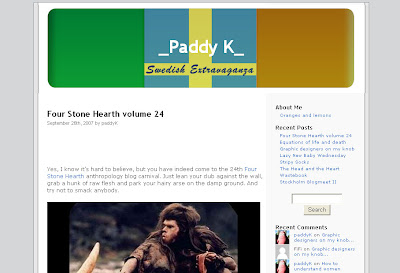
Four Stone Hearth - Volume 24

Paddy K hosts this volume of Four Stone Hearth's always-informative multi-blog travelling carnival of social sciences, adding a tinge of irreverent humour to make it entertaining too:

Click here...

And we can scroll down to find: "Glen over at Paleoglot gives us a few thoughts on sexuality and history and how it is impossible to separate one from the other, no matter how many flag-waving moralists are camped on your front lawn."

Lol! I couldn't have summed it up better myself. In fact, maybe that's how I should have worded it in that article. Enjoy!

31 Aug 2007

Four Stone Hearth: Volume 22

Get your latest Four Stone Hearth fix while it's hot. The latest issue is provided to you by the Hominin Dental Anthro blogsite and can be accessed directly via the link below:

Four Stone Hearth: Volume 22

Bon appétit!

16 Aug 2007

Four Stone Hearth: Volume 21

It's that time of month. As scheduled, Archaeolog hosts Volume 21 of the Four Stone Hearth blog carnival.

Four Stone Hearth: Volume 21

Read it while it's hot.

26 Jul 2007

Sherdnerd hosts Four Stone Hearth and spreads scholarly love my way

I forgot to take my happy pills this week. Just when you think you're unloved, the world is getting dumber and we're all going to die in an ominous mushroom cloud of atomic radiation, badabing! Hugs and kisses come out of nowhere and smack you upside the head to brighten your day. Go figure.

I was scoping the internet today and visited the Four Stone Hearth website again. This link was an interesting tip-off provided by one of my visitors and so I've been lurking on it lately to see what it's all about. It calls itself a "blog carnival" and it chooses other bloggers to host each installment every two weeks. From what I gather, each bi-weekly host then submits content on their own blog as a holy offering to Four Stone Hearth. In this way, it provides readers with a steady, meaty collection of informative leads on topics relating to the social sciences and helps bloggers combine their readership together to make their input more visible. Wow! I have to say it's got me hooked. A fabulous idea. See, Wikipedia? That's a proper use of "Web 2.0". Bad Wikipedia, bad!

So moving on, it turns out that a Egyptology blog called Sherdnerd recently hosted the 19th installment of Four Stone Hearth. And looky, looky...

To my shock I'm mentioned there in company with Abnormal Interests, a very intelligent blog that I uncovered some time ago through the article By the Numbers concerning Egyptian numerals written in cuneiform script during the Middle Kingdom.

Well, geez Louise. The pressure's on. I better get snappy and pull up my sport socks then. No more boozing for ol' Glenny on the weekends. Time to crack open more of those library books and blog, blog, blog!