Showing posts with label germanic. Show all posts

29 Dec 2010

Etruscan trees and related grerbage


No, it's not a typo - I really did mean to type grerbage. According to Anderson (2003)[1], a distinct lexical contrast between the tree versus the generalized grerb had existed in Latin, West Germanic, and East Germanic as opposed to North Germanic which had a slightly different contrast between tree versus grass. These possible taxonomical differences and global tendencies might be helpful to details of ancient semantics.

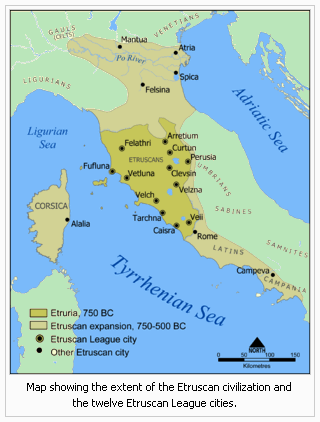
If Etruscan lied geographically between Germanic and Latin, could Etruscan also show a similar lexical pattern? Furthermore if Proto-Aegean *árapu (previously explained on my blog) evolved to Cyprian *arpu and it was loaned into Latin through Etruscan as arbos ~ arbor 'tree', could it be this early Proto-Etrusco-Rhaetic language that had sparked this specialization of floral terms when it expanded early in the 1st millennium across the Alps? Were neighbouring languages Venetic, Celtic, Umbrian, North Picene and South Picene also implicated in this sphere of increasing nuance in plant vocabulary?


NOTES
[1] Anderson, Folk-taxonomies in early English (2003), pp.366-7 (see link).

27 Nov 2010

The bear taboo


According to The linguistics encyclopedia (2002), p.237:
"Taboos may even cause the loss of a word, as in the classical Indo-European case of the word for 'bear'. [...] Avoidance of the term is thought to have occurred in the northern Indo-European regions, where the bear was prevalent, and another name, (employed, perhaps, not to offend it), was substituted in the form of *ber- 'brown'; that is, 'the brown one'."
Now, upon reading accounts like this, the first question that comes to me is this: How can one know with any degree of certainty that this word had been displaced in Germanic, Baltic and Slavic because of taboo and not because of garden-variety lexical replacement? In Slavic, 'bear' is replaced by a new word meaning 'honey-eater', unrelated to Germanic's choice of 'brown one'. This is exaggerated as a 'circumlocution' in keeping with the assumption of taboo but if these sorts of creative epithets constitute in themselves evidence for taboo replacement, then could we not then claim that any new word coined is a "circumlocution" or "taboo" for the original term? Should we start insisting that Latin aqua 'water' is a taboo replacement for *wódr̥ too? It's rather convenient to pin taboo explanations on the vocabulary of obscure northern cultures that lacked written records.

Sure, no one can deny that the bear was a powerful symbol to northern European cultures for millennia, but if we replace 'bear' in the above quote with 'pickle', the emptiness of this taboo assumption becomes a little clearer.

4 Oct 2010

Vetch and pea sail to Italy


There are many things to discuss lately. For example, on Phoenix's blog, Proto-Indo-European reduplication is revisited and I might have a few more thoughts on this. However, for now I'll complete the short thread concerning my previous suggestion of Aegean roots for 'pulse' and 'vetch', this time slightly modified to *árapu (> Minoan *árapu > Gk ὄροβος 'bitter vetch') and derivative *árapinta (> Minoan *arápinta > Gk ἐρέβινθος 'chick-pea').

What I wanted to share is that there are further interesting comparanda apparently isolated in Western Europe that many other scholars also believe are indicative of some sort of substrate, although no one is very specific about its transmission. Of course, as always, it's this vagueness that drives me nuts, so let's explore this more:
  • Latin ervum 'pulse, bitter vetch'
  • Germanic *arwītō 'pea' (hence OHG arawiz)
As anyone can see, it's relationship to Gk ἐρέβινθος is clear. Yet trying to explain this away with Indo-European roots isn't the solution here. Some Indoeuropeanists have nonetheless attempted to reconstruct some ridiculous roots like (*)*orgʷindʰ- or (*)*h₃ergʷindʰ, for example, which fails to address the incoherence of Germanic *-w- beside Greek -b-, not to mention the erratic vocalism (ie. Germanic *ar- vs. Greek er-)! Surely a substrate word must be at work here, not an inherited Indo-European root with a whack-load of irregular sound changes.

Then there's also Latin arbōs ~ arbor 'tree'. According to the OED, Latin arbōs is of "unknown origin". As usual, some obsessive Indoeuropeanists have attempted to explain this word away as yet another IE root (eg. Julius Pokorny and *erəd- 'to grow'). These numerous "Western IE" roots fail to convince and it's interesting that arbōs is localized purely within the Italic branch. For that matter, what other Italic cognates exist alongside this Latin term, if any?

I'm also interested in the history of Latin herba 'grass'. If we include this and arbōs as part of the substrate evidence, could the meaning of this underlying root be more general such as 'sprout', I wonder. I'll have to look further and see what other ideas have been published on these interesting words.

If we trek onward and theorize an Etrusco-Rhaetic cognate in Italy, and given my latest rules of sound correspondence, we should then expect *arpu 'sprout', which would explain both ervum and arbōs in Latin, and *arpintʰ 'pea', which would explain Germanic *arwītō (perhaps via a Venetic intermediary, *arwi(n)ton).

24 Jun 2010

The 'god' word in Europe


I'm mired in a giant can of worms here. After pondering deeply the past week on all the exact details of the origin of the Etruscan word ais 'deity', I find myself not only skeptical of the direction this word traveled but also even more intrigued now of how widespread a common set of mythic traditions are. Most authors seem to be writing that the word ais spread from Etruscan into the various Italic languages. Whereas another interesting possibility I'm exploring is that it went in the other direction, from some Italic language (probably Umbrian *aisos) into Etruscan before 700 BCE.

If the Italic form was *aissos (perhaps from *h₂éisdtos '', let's say), it's interesting that the Germanic form for 'god' is so similar, *ansuz. At first I was thinking that maybe the *-n- isn't really there, maybe an etymological fantasy. However the association between different variants of the same names in different Germanic languages (eg. Ásgeir vs. Ansgar, literally 'god-spear') would assure us that the *-n- was probably there. It would almost look like a borrowing if it weren't for that *-n- in place of *-i-. Then again, what if the Germanic word were a borrowing and were originally **aisuz. With later contamination with the similar word *ansaz 'beam' due to a cosmic analogy between the structure of their universe and the structure of a house (ie. the roof = sky, the beams = gods, the supports = dwarves, etc.), we have a motive for the odd theoretical change.[1]

Curiously, we also have the Celtic god Esus which, after reading up on the basics of his myth, I'm convinced he's equivalent to one the aspects of the Etruscan solar trinity, Tinia Thufl 'Tinia of Oath'. I've spoken of this trinity before. Esus is also part of a Celtic triad involving Taranis and Teutates, which again can be matched perfectly with Etruscan Tinia Thneth 'Tinia of Thunder' and Tinia Cilensl 'Tinia of Darkness' respectively.

So now I wonder if there's a chance that these forms spread from Italic to Celtic and onward to Germanic particularly between 500 and 200 BCE. I'll have to think through this some more. There's still so much to read. Will I live long enough to know everything? ;o)


NOTES
[1] Bandle/Elmevik/Widmark. The Nordic languages: An international handbook of the history of the Germanic languages (2002), p.400 (see link); Liberman, An analytic dictionary of English etymology: an introduction (2008), p.49 (see link).

4 Mar 2010

My sweet honey bee

The Indo-European word for 'honey', I have to confess, has always bothered me. Technically *mélit displays proper form with full-grade in the accented syllable and zero-grade in the unaccented and it also is supported by reflexes in Celtic, Germanic, Latin, Greek and Anatolian languages. Yet...

Douglas and Adams inadvertently uncovers a problem with this irreproachable hypothesis at the bottom of page 262 of The Oxford introduction to Proto-Indo-European and the Proto-Indo-European world (2006): "The noun *mélit is found widely in the West and Centre (e.g. OIr mil 'honey', Lat mel 'honey', NE mildew [< *'sweet sap'], Alb bletë 'honey-bee', Grk méli 'honey', mélissa 'honey-bee', Arm melr 'honey', including Anatolian, e.g. Hit militt- 'honey') and has one Iranian cognate in the form of a reference to melition, a drink of the Scythians."

Naturally we should ask: Why is the distribution of this word west and center? And you've probably surmised that I'm thinking of a possible Aegean explanation for what appears to be nothing more than a wanderword. A more valid PIE root for 'honey' might best be sought in the more-fully-attested root *médʰu, normally assigned the value of 'mead', a wine made from fermented honey.

What I'm pondering on is the possibility that only the Anatolian forms for 'honey' are truly Indo-European but which represent some innovative derivative from a native root. From there, Anatolian *mélit would be borrowed into Aegean as *méli with other related borrowings like *malítu 'sweet' (cf. Britomartis) which would in turn be borrowed into Greek. By the onset of the 1st millenium BCE, Proto-Cyprian *meli 'honey' and *mlitu 'sweet' would yield Old Etruscan *mel and *mliθ via early syncope. Once the Etruscans arrived in Italy, the early Latini could have easily borrowed the Etruscan term, thus Latin mel. These terms, along with their Etruscan-derived runes, could then have also travelled eventually to the Germani and among the Celts.

That would certainly explain the distribution a lot better than the standard Indo-European-based theory.

26 Oct 2009

Searching for an etymology for Germanic *handuz 'hand'

First, let's get nonsense out of the way by letting a published author state the obvious about origins of the Proto-Germanic etymon *handuz 'hand' that are most implausible yet unfortunately popular among idle hobbyists online. In the words of A. Seidenberg in km, a widespread root for ten (1976):
"The effort to relate km or kmt to *handus, or, more generally said, to see a reference to the hands in the number words, is also ad hoc: there is not the slightest evidence, apart from similar speculations on the other numbers, that the Indo-European number words are derived from finger-counting."
These comments on poor methodology are as true today as they were then, regardless of whether this old tomfoolery is resurrected on page 316 of Mallory/Adams in The Oxford introduction to Proto-Indo-European and the Proto-Indo-European world (2006 ), albeit subsequently with mild argumentation against the idea.

What then is the current etymology? Apparently no consensus exists yet. For example, The Barnhart dictionary of etymology‎ (1988) says that no cognates of hand exist outside of Germanic. While it's immediately tempting to see an origin in PIE *gʰend- 'to grasp' which yielded Latin praehendere, Greek χανδάνειν and Gothic bi-gitan, formal sound correspondences between PIE and Proto-Germanic forbid us to assume a direct connection with the Germanic root. One would expect a hypothetical PIE u-stem **gʰóndus 'grasper; hand' to end up as **gantuz in Proto-Germanic but certainly not *handuz which rather suggests a non-existent PIE stem **kondʰ-u-. Evidently, these are not the plosives we're looking for and no direct link to Proto-Indo-European appears sensible.

So I had a sudden brainwave and the more I think about it the more sense it makes, although it's frustratingly hard to substantiate. Since there are already a few known Proto-Germanic terms borrowed from Latin in the early first millenium BCE after Grimm's Law had taken place (cf. Ringe, From Proto-Indo-European to Proto-Germanic (2006), p.296), it makes me wonder if one of them might have been our Germanic word in question.

For this crazy idea to stick, we require a Latin word *handus, but as the reader can tell by the asterisk, it doesn't exist (at least as far as I know). On the other hand, prae-hendere 'to seize, to grasp' does indeed exist and the prefix prae- 'before' is secondary. From this implied Latin verb root *hend-, we are certainly free to muse light-heartedly on how we can obtain *handus 'grasper' from it, and very curiously, noting on how it rhymes with the attested Latin word for 'hand', manus. It taunts me with the image of a northern Germanic community with a high degree of Latin bilingualism, inventing new words and idioms out of a faraway language. If only my Germanic-influenced Latin word *handus for proper manus were attested in Roman records, I might develop something more out of this thought.

4 Jun 2008

On the origin of the Etruscan word lautun

Just a quick note on this puzzling Etruscan word, lautun, translated as 'family' by Larissa Bonfante[1]. I notice that Douglas Kilday has beat me to the punch on the etymology of the word which I'm currently obsessed with at the moment. He has more or less made the same observations on the sci.lang forum that I also have: that it's a borrowed term, that it's not from Italic, and that it's nonetheless surely derived from a word based on the root *h₁leudʰ- from an Indo-European language[2].

So far, unless anyone can think of anything better, I'm convinced that Proto-Germanic is the likeliest the source. Proto-Germanic already contains the word *leudiz 'people' so it would be nice if I could find a word that looks like **leudōn lying around. So far, I haven't found anything and yet I can't help but think there's got to be a clue here somewhere.


NOTES
[1] Bonfante/Bonfante, The Etruscan Language: An Introduction (2002), 2d ed., originally published in 1983, p.217 (see link).
[2] Douglas G. Kilday, sci.lang: "Some non-italic IE loanwords in Etruscan" (Dec 06 2002 10:46).

2 Jun 2008

The origin of the cityname Arretium still bugs me

This etymological puzzle is starting to consume my daily thoughts. The Etruscan name for Arretium, as I mentioned earlier, appears to be Aritim, at least according to Steinbauer[1]. I now think he's correct. However, if this is so, any distinctly Etruscan connection that Pallottino had claimed existed between the Roman urbonym Arretium and the modern German word for 'ore', Erz, is smashed. Yet there are more nagging details about these etymologies that I just don't find convincing.

For example, the claim that the Germanic words for 'ore' derive from Arretium seems like the reverse of what I personally would deduce from the evidence. It's the Germanic terms that are shorter than the name from which they purportedly derive, afterall, and this is mightily suspect to me. One would almost reckon instead that the name of Arretium derived from the Germanic words for 'ore'. And why not? It seems to me that Etruscologists are obsessed with the thought that Arretium must have been founded by Etruscans. Yet beyond the fact that the city was Etruscan from the most ancient historical times, what evidence exists that the Etruscans also established it in prehistory as opposed to taking it over from indigenous peoples like the Italic or Germanic population? All I see so far is a city positioned remotely in the interior of Italy in the northernmost region of Etruria that by all accounts has been shaped from the earliest times by not only Etruscans, but Italic-speaking and Germanic-speaking populations as well.

So I was thinking the other day, “What if 'Arretium' was originally a Germanic name?” It's a delicious thought that I can't pass up. I'm tempted to posit a form like *Arutjōn signifying 'Ore Town' (< *arutja- 'ore' plus derivational suffix *-ōn as in *bijōn- 'bee'). The city was known for its bronze and so such a name would be apt. From there, Latin-speaking people could have assimilated the name as Arretium very easily. The Etruscans would in turn have borrowed it directly from the Latin speakers, as indicated by the word-final -m. Aritim is not an analysable name in Etruscan terms, so I'm entirely convinced that it's a foreign name one way or another and that regardless of the Etruscan political history of this town, the whole thing is making me believe that the cultural mix of Arretium in prehistoric times was much more complex than currently appreciated.


NOTES
[1] Steinbauer, "Zur Grabinschrif der Larthi Cilnei aus Aritim/Arretium/Arezzo", Zeitschrift für Papyrologie und Epigraphik 121 (1998), p.263–281 (see pdf).

28 May 2008

Arretium versus German Erz and how this affects (or doesn't affect) Etruscan Aritimi

I found more odd gibberish from the Etruscologist Massimo Pallottino the other day. This time it's a claim of his that the cityname of a Roman city, Arretium, is in some way connected with German Erz 'ore'[1].

This ties in to my ongoing dilemma concerning whether Aritimi in TLE 737 means 'Artemis' or 'in Arretium'. Larissa Bonfante and Erika Simon continue to publish the claim that Aritimi points to 'Artemis' instead[2]. I have to say that I'm really finding that the status quo view that Aritimi and Artume are the same word to be implausible due to phonetic incongruence between the two terms, if not due to contextual issues as well. I've currently come to the conclusion that we have two different words with similar sounds: Aritim 'Arretium' (a Roman city) and Artume 'Artemis', the latter being obviously borrowed from the Greek name Artemis. In another Etruscan inscription[3], a phrase reads An Aritimi meani arasince and appears to me to mean 'She (an) was raised (arasince) in Arretium (Aritimi) in youth (meani)'. There's no way that I can see on the other hand how I might be able to fit the value 'Artemis' in that sentence without it sounding contrived. And thus, these experts have lied to me again! Grrr!!!

What has held me back from splitting these two terms into separate entries so far is the phrase Aritimi-pi Turan-pi of TLE 45 which has been traditionally claimed to mean 'to Artemis and to Turan'. Without a picture available to me, I can't yet prove for myself whether the reading is correct but the letters of the Etruscan text are transcribed this way by the invaluable Helmut Rix in Etruskische Texte (1991). Grammatically, it seems to me that -pi is a postclitic with a locative connotation, much like -θi 'in'. It's elsewhere used with the oblique case form of the first person singular pronoun mi, hence mini-pi (note TLE 12 and TLE 13) which probably means 'by me'. Note however that if the translation of the aforementioned phrase were correct, we'd expect the presence of the conjunctive -c attached to the last member of the pair to convey 'and'. Considering its absence, there's reasonable doubt that the translation may be incorrect. Conversely, nothing stops me from applying the value of 'Arretium' here. The idea of Aritimi-pi Turan-pi meaning 'before Turan in Arretium' makes more grammatical sense to me. Afterall, in this way, we may then pluck out the noun phrase Aritimi Turan, which would be an epithet meaning 'Turan in Arretium' (note TLE 393: Selvanzl Enizpe-tla = 'To Selvans in (the city) Enispe'). From there, the application of a case ending or postclitic to both members of such a noun phrase is perfectly acceptable in Etruscan, as well as in Lemnian (Hulaie-śi Φukiasi-ale 'to Hulaie the Phocaean'). Sufficed to say then, I will be updating my database in the next draft modification in July so hold on tight.

Back to Pallottino's claim, if Aritim can thereby be kosherly translated as the cityname Arretium as some scholars have already previously published[4], then how does Pallottino get from Aritim to German Erz? From what I see, he's just made another crazy claim without linguistic justification. The word Erz has also been attributed to a Proto-Germanic root *arutaz. Even so, if Aritim really meant 'Arretium', it surely is borrowed from Latin Arrētium, and has nothing at all to do with the Germanic terms for 'ore' because the second vowel, *-u- (as in OHG aruzzi), is incongruous with the phonetic reality of both the Latin and Etruscan terms. So these weakly researched comparisons between Indo-European languages and Etruscan simply have to go, I'm afraid. Caveat pensator.


NOTES
[1] Pallottino, The Etruscans (1975), p.95 (see link): "Such contacts between Germany and Etruria are confirmed by the German word Erz, 'metal', which comes from the name of the Etruscan city of Arrētium, Arezzo, famous for its working on metal.".
[2] Bonfante/Bonfante, The Etruscan Language: An Introduction (2002), p.80 (see link). Erika Simon merely parrots the same in De Grummond/Simon, The religion of the Etruscans (2006), p.46 (see link).
[3] Steinbauer, "Zur Grabinschrif der Larthi Cilnei aus Aritim/Arretium/Arezzo", Zeitschrift für Papyrologie und Epigraphik 121 (1998), p.263–281 (see pdf).
[4] See for example Steinbauer, "Zur Grabinschrif der Larthi Cilnei aus Aritim/Arretium/Arezzo", Zeitschrift für Papyrologie und Epigraphik 121 (1998), p.263–281 (see pdf). On the website etruskische.de, Steinbauer's translation is also asserted.